I’ve devoted much of this blog to challenging the stereotype that classical composers are all “dead, white men,” even though the canon makes it seem that way. So far, I’ve only addressed the “men” part, in several posts and a guest post.
Yet I haven’t written as much about the “white” part, mostly because it’s uncomfortable to discuss racism as a white person in the US—especially in connection to something I love, something I’ve built into my identity. It’s hard to talk from the privileged position without inadvertently making assumptions (which is why I’ve sent drafts of this post to many people for feedback).
But recent events have challenged my perspective, to the point that the “whiteness” of classical music is something I can’t not address anymore. I must push beyond any discomfort because this is a conversation that needs to happen, especially in the current political environment.
Showing posts with label How to fix classical music. Show all posts
Showing posts with label How to fix classical music. Show all posts
Thursday, September 27, 2018

Friday, April 20, 2018
What should we call classical music?
In March 2018, The Telegraph published an article that had classical music aficionados up in arms. Although it doesn’t take much to agitate this crowd, the headline was indeed provocative:
My initial reaction was similar to that of my music scholar colleagues: “What?! There is so much classical music that isn’t orchestral! What about opera? Solo works? Songs? Chamber music? Choral music?” and so on, naming as many genres of non-orchestral classical music as we could to show just how wrong, wrong, WRONG that idea is.
But when I actually took the time to read the article, I realized that the headline was misleading—likely intentionally so, to stoke those flames of OUTRAGE! that generate page views…
…because that’s not actually what the Royal Philharmonic Orchestra’s (RPO) managing director James Williams said.
My initial reaction was similar to that of my music scholar colleagues: “What?! There is so much classical music that isn’t orchestral! What about opera? Solo works? Songs? Chamber music? Choral music?” and so on, naming as many genres of non-orchestral classical music as we could to show just how wrong, wrong, WRONG that idea is.
But when I actually took the time to read the article, I realized that the headline was misleading—likely intentionally so, to stoke those flames of OUTRAGE! that generate page views…
…because that’s not actually what the Royal Philharmonic Orchestra’s (RPO) managing director James Williams said.
Thursday, April 12, 2018
The Halls are Alive: Essay for VAN Magazine
Hello! Even though I haven't been updating the blog lately, I have been busy with other musicological endeavors. I discussed music, art, and philosophy on a local podcast (which hasn't posted yet), and I had a chat with BBC Radio 3's Tom Service for an upcoming episode of The Listening Service about my stance on whether music is a universal language. I'll post links to these once they go live.
Meanwhile, here's my latest article for VAN Magazine (who previously published my essay, "Classical Music Isn't Cool"): "The Halls are Alive."
I've also had a paper accepted to the "Music and Musicology in the Age of Post-Truth" conference in Dublin next September, and I've been writing program notes for a few new clients. Even so, I'm hoping to have a new post on The Telegraph's argument that "Classical music must ditch its name." Exciting times ahead!
Like what you’ve read?
Meanwhile, here's my latest article for VAN Magazine (who previously published my essay, "Classical Music Isn't Cool"): "The Halls are Alive."
 |
"So many facets of classical music culture are holdovers from the 19th century and at odds with 21st century society....Yet in this essay I defend the most Romantic of 19th-century institutions: the concert hall. Yes, the physical manifestations of music worship, structures so Romantic that they wouldn’t be foreign to Richard Wagner. Though some argue that the etiquette for concert halls is outdated, elitist, and partly responsible for classical music’s struggle to find new audiences, concert halls actually provide unique experiences that have become all too rare." Read more »
I've also had a paper accepted to the "Music and Musicology in the Age of Post-Truth" conference in Dublin next September, and I've been writing program notes for a few new clients. Even so, I'm hoping to have a new post on The Telegraph's argument that "Classical music must ditch its name." Exciting times ahead!
Like what you’ve read?
Wednesday, December 27, 2017
The Myth of the Canon's Invisible Hand (Guest post by Anne C. Shreffler)
From Linda: Hello, everyone! This year has been remarkable for (among other things) public debates about women's experiences in our society, from the Women's March to the #metoo campaign. Just as the previous two posts on this blog have featured a multitude of voices, this post comes from someone else: Harvard musicologist Anne Shreffler. Many thanks to Dr. Shreffler for contributing to our continued discussion of the classical music canon.
“But isn’t musical quality more important than gender?”
Anyone who has ever proposed a greater inclusion of women composers and composers of color—into a curriculum, a concert program, or an archive—is familiar with this kind of response. One of the most persistent myths in music history is that the classical music canon came about as the result of a rational, inevitable process that ensured the preservation of only the "best" works, those that "stood the test of time." An influential proponent of this view was the German musicologist Carl Dahlhaus, who maintained in 1977 that the musical canon was not made but "found." According to Dahlhaus, we can't shape or change the canon, since it was created long ago by the invisible hand of tradition.
How exactly is this selection process supposed to have worked? One imagines a fictional court of justice in the heavenly spheres, presided over by—whom? (God? St. Cecilia? Herbert von Karajan?), that conducts annual reviews of ALL the compositions by ALL the people, and hands down impartial judgment on their "musical quality." The verdict: Sibelius, yes; his contemporaries Amy Beach and Will Marion Cook, no.
 |
| Beethoven, the disembodied name of a musical deity, in Boston's Symphony Hall |
Anyone who has ever proposed a greater inclusion of women composers and composers of color—into a curriculum, a concert program, or an archive—is familiar with this kind of response. One of the most persistent myths in music history is that the classical music canon came about as the result of a rational, inevitable process that ensured the preservation of only the "best" works, those that "stood the test of time." An influential proponent of this view was the German musicologist Carl Dahlhaus, who maintained in 1977 that the musical canon was not made but "found." According to Dahlhaus, we can't shape or change the canon, since it was created long ago by the invisible hand of tradition.
How exactly is this selection process supposed to have worked? One imagines a fictional court of justice in the heavenly spheres, presided over by—whom? (God? St. Cecilia? Herbert von Karajan?), that conducts annual reviews of ALL the compositions by ALL the people, and hands down impartial judgment on their "musical quality." The verdict: Sibelius, yes; his contemporaries Amy Beach and Will Marion Cook, no.
Wednesday, December 20, 2017
The "reception and perception of women composers" (Tweets about Women Composers, part 2)
 |
| Cécile Chaminade wonders when she'll be heard on the radio as often as Maurice Duruflé. |
Again, I've chosen to embed the Tweets rather than transcribe them so you may interact with them if you'd like.
As the conversation went on, "symphonic rabble rouser" Emily E. Hogstad had a substantial amount to say:
Thinking about the reception and perception of female composers after reading several interesting threads starring @K_Leonard_PhD @MWilsonKimber @LindaHyphen and others... 1/?— Emily E Hogstad (@song_of_lark) December 19, 2017
I loved this observation by @MWilsonKimber. Even an amateur historian like me can attest: this is SO TRUE, and you can see it simply by reading about historical musical women or (better yet) consulting old newspapers. 3/? pic.twitter.com/B796aBprjC— Emily E Hogstad (@song_of_lark) December 19, 2017
The most striking example I've personally come across was this Amy Beach Minneapolis Symphony review from 1917, which I tweeted earlier this year. 4/? pic.twitter.com/ZtjZfaRk9y— Emily E Hogstad (@song_of_lark) December 19, 2017
Tuesday, December 19, 2017
If we've never heard of women composers from past centuries, does that mean they didn't exist? (Tweets about Women Composers, part 1)
 |
| Amy Beach, an actual woman composer of the 19th century! |
It began with musicologist Kendra Leonard asking a music history account about their OTDs ("On This Date"):
Hey @musihist, what happened OTD in music history that isn't about a man? How about tomorrow? And the day after that?— (((Kendra Leonard))) (@K_Leonard_PhD) December 15, 2017
Follow us and find out.— MusicandHistory (@musihist) December 15, 2017
Since Dec 1, you've posted more than 150 tweets. Only two are about women. That's a terrible ratio. https://t.co/8Uq1C94YtP— (((Kendra Leonard))) (@K_Leonard_PhD) December 18, 2017
And THERE is the myth! Dr. Leonard summoned me:We can't change the fact that until very recently, women in western music were discouraged from pursuing composition. But we try to make known those who did, and are, creating great works.— MusicandHistory (@musihist) December 18, 2017
Note: She used my personal Twitter handle (@LindaHypen) instead of the one I use only for this blog (@MusHistCliches). Feel free to follow this account for musicological discussions like this one, but be aware that I also tweet about my cancer, my son, and my cat..@LindaHyphen want to take on the fallacious argument here that this site/account can't post equally about women because of biased historiography? https://t.co/kfbl7osESZ— (((Kendra Leonard))) (@K_Leonard_PhD) December 18, 2017
Like many myths, it is based on a bit of truth: Women have historically been discouraged from composing. (Unfortunately, this continues today, for reasons that will be explained by someone else later in this post.) I've even gotten into a different Twitter discussion about this, with Fanny Mendelssohn Hensel as the prime example.
Just as women in general have been encouraged to focus on domestic matters and not work outside the home, they were discouraged from seeking advanced training in composition because it would distract from their household responsibilities. As Abraham Mendelssohn told his daughter Fanny, "for you [music] can and must only be an ornament, never the basis of your being and doing."
So, what makes this a myth?
Thursday, February 9, 2017
Classical music isn't "cool": Essay for VAN Magazine
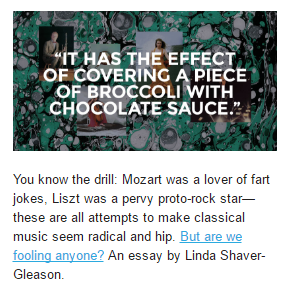
I have another debunking post in the works, but in the meantime, I wrote an essay for VAN Magazine about the cliché of equating composers with rock stars: "Classical Music Isn't Cool." Rather than give you a preview paragraph, this time I'll show you how VAN promoted it in their weekly newsletter:
Since I couldn't in the essay, I'd like to take this opportunity to thank Emma Parker, Sarah Elaine Neill, Andrew Dell'Antonio, and Carl Shaver for their feedback on early drafts.
Perhaps you disagree with my bold assertion, and hearing about Berlioz's drug use is what got you to check out Symphonie Fantastique. If so, let me know! I'd love to hear other perspectives on this topic.
Next time: I scrutinize a potential solution to Elgar's enigma, and one news outlet's coverage of it.
Perhaps you disagree with my bold assertion, and hearing about Berlioz's drug use is what got you to check out Symphonie Fantastique. If so, let me know! I'd love to hear other perspectives on this topic.
Next time: I scrutinize a potential solution to Elgar's enigma, and one news outlet's coverage of it.
Thursday, September 1, 2016
Do you have to be so snobby about classical music? (Part 1 of ?)
I have to confess, my original intent for this post was much grander than what I ended up with. I had two recent examples of classical music snobbery from opposite ends of the silly/serious spectrum: a listicle about being a classical musician, and an online discussion about a scholarly book about musicology. Both of them make assumptions about what should be considered “real” classical music, and I wanted to use them to make a greater point about how classical music is policed at every level: Is the audience knowledgeable enough? Do the performers play the right repertoire? Do the composers write in the proper style? Do the scholars say the right things? When it comes down to it, these questions are built on snobbery.
But the cliché of snobs liking classical music (or classical music being for snobs) is just too big for any one post, and trying to tackle all of it at once gave me writers’ block. So instead, this might just turn into an ongoing series where I call out classical music snobbery as I see it and offer suggestions to help steer things in a more constructive direction.
But the cliché of snobs liking classical music (or classical music being for snobs) is just too big for any one post, and trying to tackle all of it at once gave me writers’ block. So instead, this might just turn into an ongoing series where I call out classical music snobbery as I see it and offer suggestions to help steer things in a more constructive direction.
Monday, June 20, 2016
You can’t change the canon…or can you?
Earlier this month, the annual conference of the League of American Orchestras met in Baltimore to discuss, among other things, the future of live classical music. Music critic Anne Midgette covered the conference for The Washington Post with an article about how musicians are tackling existential questions, reconsidering orchestras’ missions and even the purpose of concerts in the 21st century. One quote from the conference caught a lot of attention, particularly on Twitter:
But I don’t think Laing meant his words literally, so I’m not going to pillory him. He’s a musician; I suspect he said it with resignation, maybe even some frustration. Yes, you can change the canon, but inertia has made it difficult to do so. The concept of the canon developed about 200 years ago, and while individual works have gained and lost canonic status, the idea of THE CANON remains a significant influence on concert and radio programming.
I re-tweeted Simon Brackenborough’s response, thinking defiantly, “Hells yeah! We can change the canon!” As a Good Musical Citizen and Friend to Composers, that’s the reaction that feels correct. Despite the religious connotations of the term “canon,” it wasn’t ordained by God. Humans made the canon, and humans can change the canon—in fact, it’s been in a constant state of change since its inception. So, in the literal sense, Laing’s statement is false.No. You're thinking of the laws of physics. You can definitely change the canon. pic.twitter.com/rmba0ftQlV— Simon Brackenborough (@sbrackenborough) June 15, 2016
But I don’t think Laing meant his words literally, so I’m not going to pillory him. He’s a musician; I suspect he said it with resignation, maybe even some frustration. Yes, you can change the canon, but inertia has made it difficult to do so. The concept of the canon developed about 200 years ago, and while individual works have gained and lost canonic status, the idea of THE CANON remains a significant influence on concert and radio programming.
Sunday, June 5, 2016
Will these suggestions make classical concerts less "stifling"?
Classical music needs to attract new listeners. This isn't news. Pretty much anyone who cares about the future of classical music realizes this, and to believe otherwise is to be in denial. This isn't another hand-wringing pronouncement that "Classical music is dying!"—it's an acknowledgment that classical music is subject to cultural forces and needs to build audiences with each generation in order to endure.
How to attract these new listeners remains the subject of debate. Some have proposed augmenting the concert experience, adding features that might help the highly sough-after "millennials" feel more at ease during a live performance—such as these listening guides by the Toronto Symphony Orchestra, which use notation that resembles video games such as Rock Band to explain form. Some argue that the concert experience itself need to change, due to classical music's image problem: it's too stuffy and old fashioned, and concert traditions are alienating.
Toronto critic Michael Vincent falls into this latter camp (though the positions I mentioned are not mutually exclusive, nor are they comprehensive). Earlier this week, he published a list of "Nine Things That Should Change About Classical Music." He explains, "[T]he concert etiquette at classical music performances can be a stifling experience for newbies attending symphony concerts."
Having taught music appreciation classes at UCSB, I agree with that assessment. Many of my students expressed confusion over certain traditions, including ones on Vincent's list. I like that Vincent focuses on the rituals surrounding music rather than the music itself; despite the headline, he is pointing out aspects of classical concerts he thinks should change.
How to attract these new listeners remains the subject of debate. Some have proposed augmenting the concert experience, adding features that might help the highly sough-after "millennials" feel more at ease during a live performance—such as these listening guides by the Toronto Symphony Orchestra, which use notation that resembles video games such as Rock Band to explain form. Some argue that the concert experience itself need to change, due to classical music's image problem: it's too stuffy and old fashioned, and concert traditions are alienating.
Toronto critic Michael Vincent falls into this latter camp (though the positions I mentioned are not mutually exclusive, nor are they comprehensive). Earlier this week, he published a list of "Nine Things That Should Change About Classical Music." He explains, "[T]he concert etiquette at classical music performances can be a stifling experience for newbies attending symphony concerts."
Having taught music appreciation classes at UCSB, I agree with that assessment. Many of my students expressed confusion over certain traditions, including ones on Vincent's list. I like that Vincent focuses on the rituals surrounding music rather than the music itself; despite the headline, he is pointing out aspects of classical concerts he thinks should change.
Subscribe to:
Posts (Atom)