In March 2018, The Telegraph published an article that had classical music aficionados up in arms. Although it doesn’t take much to agitate this crowd, the headline was indeed provocative:
My initial reaction was similar to that of my music scholar colleagues: “What?! There is so much classical music that isn’t orchestral! What about opera? Solo works? Songs? Chamber music? Choral music?” and so on, naming as many genres of non-orchestral classical music as we could to show just how wrong, wrong, WRONG that idea is.
But when I actually took the time to read the article, I realized that the headline was misleading—likely intentionally so, to stoke those flames of OUTRAGE! that generate page views…
…because that’s not actually what the Royal Philharmonic Orchestra’s (RPO) managing director James Williams said.
Showing posts with label Mozart. Show all posts
Showing posts with label Mozart. Show all posts
Friday, April 20, 2018

Thursday, February 9, 2017
Classical music isn't "cool": Essay for VAN Magazine
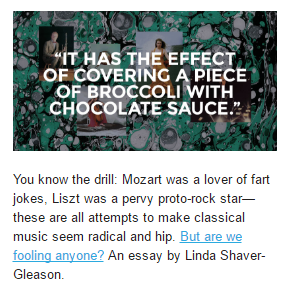
I have another debunking post in the works, but in the meantime, I wrote an essay for VAN Magazine about the cliché of equating composers with rock stars: "Classical Music Isn't Cool." Rather than give you a preview paragraph, this time I'll show you how VAN promoted it in their weekly newsletter:
Since I couldn't in the essay, I'd like to take this opportunity to thank Emma Parker, Sarah Elaine Neill, Andrew Dell'Antonio, and Carl Shaver for their feedback on early drafts.
Perhaps you disagree with my bold assertion, and hearing about Berlioz's drug use is what got you to check out Symphonie Fantastique. If so, let me know! I'd love to hear other perspectives on this topic.
Next time: I scrutinize a potential solution to Elgar's enigma, and one news outlet's coverage of it.
Perhaps you disagree with my bold assertion, and hearing about Berlioz's drug use is what got you to check out Symphonie Fantastique. If so, let me know! I'd love to hear other perspectives on this topic.
Next time: I scrutinize a potential solution to Elgar's enigma, and one news outlet's coverage of it.
Tuesday, January 17, 2017
Many Mozart Myths: A pauper’s grave, labor screams, and more!
 |
| Happy 261st! Don’t worry, we’ll still treat you like you’re 11. |
Wednesday, January 11, 2017
Announcement: Guest post for The Outline
Happy New Year! I hope you’ve had a wonderful holiday season. I’ve been busy writing. Fortunately (for me, but perhaps unfortunately for this blog), I’ve been working on articles for other sites. Unlike my post for Musicology Now, however, these articles are in line with the aim of this blog: busting musical myths.
Today, The Outline published my article, “You Don’t Need Science to Tell You Why You Like a Song.” This essay is like a companion piece to one of the first posts on this blog, “Science Proves Your Favorite Music is the Best.” My earlier post explored how classical music media outlets tend to be self-congratulatory about scientific studies involving classical music. Since The Outline doesn’t focus on classical music, though, I wrote about why we place so much emphasis on scientific (or scientistic) studies of music in the first place. I still mention the Mozart Effect, but I pair it with a ridiculous formula that claims to have determined the “10 most uplifting songs ever,” which are astonishingly all Dad Rock Standards. Here’s a preview:
Today, The Outline published my article, “You Don’t Need Science to Tell You Why You Like a Song.” This essay is like a companion piece to one of the first posts on this blog, “Science Proves Your Favorite Music is the Best.” My earlier post explored how classical music media outlets tend to be self-congratulatory about scientific studies involving classical music. Since The Outline doesn’t focus on classical music, though, I wrote about why we place so much emphasis on scientific (or scientistic) studies of music in the first place. I still mention the Mozart Effect, but I pair it with a ridiculous formula that claims to have determined the “10 most uplifting songs ever,” which are astonishingly all Dad Rock Standards. Here’s a preview:
Thursday, December 8, 2016
Is this flute concerto a long-lost Mozart composition? (Probably not.)
Last week, my news feeds were full of stories about musical manuscripts and rediscovered compositions:
- On November 27, A manuscript of Mahler’s second symphony auctioned at Sotheby’s set a record for the highest sale price of a musical manuscript.
- At the same auction, a manuscript of a Beethoven piece failed to sell, and Sotheby’s blames a musicologist for voicing doubts that it’s in Beethoven’s handwriting.
- On December 2, Austria’s Tutti Mozart Orchestra premiered a long-lost flute concerto purported to be by Mozart.
- Coincidentally, that same day saw the revival of Stravinsky’s “Funeral Song,” which was lost in the Russian Revolution and recovered in 2015.
Thursday, October 6, 2016
Did 18th-century artists "struggle"?
This week, a lot of my music friends have been sharing links to the “about” page on pianist Khatia Buniatishvili’s website. It’s one of the purplest things I’ve ever read, and since I research 19th-century writing about music, that’s saying a lot. If you need a laugh, go read it right now. If you’d prefer an audio version, check out Matt Marks’s dramatic reading (which adds a suitable soundtrack).
Make no mistake, this is atrociously bad writing. My favorite sentence features one hell of a mixed metaphor:
What an image! This biography, written by French music journalist Olivier Bellamy, probably suffers from translation issues, but even that doesn’t account for the complete lack of meaning in sentences like,

That got me thinking. Yes, presenting Buniatishvili as a superhuman Artist plays to 19th-century tropes, but what strikes me is how often Bellamy invokes the 18th century.
Make no mistake, this is atrociously bad writing. My favorite sentence features one hell of a mixed metaphor:
For fun, her mother would leave a new musical score each day on her piano and, hungry, Khatia’s long, octopus-like arms would devour them.
 |
| OM NOM NOM! Image by Reddit user NeokratosRed |
By lifting one’s eyes skywards one might notice her playing hide-and-seek with either Venus or Mercury.Okay, okay, okay. Enough! So, as much as I relish the absurdity of it all, I didn’t think there was any reason to put it on my blog. Then my friend Temmo posted a link to the dramatic reading on his Facebook page, and we had the following conversation:

That got me thinking. Yes, presenting Buniatishvili as a superhuman Artist plays to 19th-century tropes, but what strikes me is how often Bellamy invokes the 18th century.
Wednesday, May 25, 2016
Science Proves Your Favorite Music is the Best
Instead of examining a single article for this post, I'm going to discuss a trend: using science to imply that classical music better than other styles.
Journalists in all fields love to report on scientific studies, but very often the science is misunderstood or misrepresented, as the journalists are usually not specialists themselves. My previous post shows one example of this lack of understanding (assuming that mistake was in Vanderbilt's reporting and not in the actual study, though I suspect the scientists wouldn't have picked the name "Buxtehude" out of the ether, so someone knew what they were doing). Comedian-journalist John Oliver discussed the media's misrepresentation of science on a recent episode of his show Last Week Tonight; if you don't have 20 minutes available to watch this funny and informative clip, you can look at this diagram from PHDComics.com covering the same topic.
When it comes to scientific studies involving music, there's a cultural component that complicates reporting. Very often, scientific studies are presented in ways that conform to our cultural expectations. That is, people love reading that classical music is good for us.
Journalists in all fields love to report on scientific studies, but very often the science is misunderstood or misrepresented, as the journalists are usually not specialists themselves. My previous post shows one example of this lack of understanding (assuming that mistake was in Vanderbilt's reporting and not in the actual study, though I suspect the scientists wouldn't have picked the name "Buxtehude" out of the ether, so someone knew what they were doing). Comedian-journalist John Oliver discussed the media's misrepresentation of science on a recent episode of his show Last Week Tonight; if you don't have 20 minutes available to watch this funny and informative clip, you can look at this diagram from PHDComics.com covering the same topic.
When it comes to scientific studies involving music, there's a cultural component that complicates reporting. Very often, scientific studies are presented in ways that conform to our cultural expectations. That is, people love reading that classical music is good for us.
Friday, May 20, 2016
Beethoven's Humanity vs. Mozart's Divinity
In my previous post, I looked at an article written by someone who probably does not have much experience covering classical music (at least, judging by the other articles she's written). It addresses some of the problems that arise when publishers assign staffers who do not have the background to write knowingly about their given subject. For this post, however, I examine an article by The Telegraph's regular classical music critic, Ivan Hewett. While his article also contains historical falsehoods, I'm more concerned about the way Hewett resorts to the most familiar stereotypes to preach to the choir.
First, some background: In a survey conducted earlier this year by Classic FM, a UK-based radio station, Beethoven had more compositions on the favorites list than Mozart. This was the first time this has happened since the annual survey started in 1996, which is enough of a change to warrant some comment. The first article The Telegraph ran on this coup, "Beethoven beats Mozart to be crowned most popular composer for first time," offers an explanation: Beethoven's seventh symphony serves as the soundtrack to an intense scene in the popular movie The King's Speech, which prompted people to seek out more of his music.
Perhaps this article was a bit too dry in its cold reporting of facts and analysis. Where is the breathless adulation of these Great Masters? So, Hewett offers his own explanation in "Why Beethoven rules supreme over Mozart." Rather than discuss why people might have adjusted their answers in the poll, he effectively proclaims that the poll has finally gotten it right.
"Beethoven is classical music's titan. More than that, he is the perfection of the romantic artist-hero," Hewett declares. Here's where my perspective as a musicologist differs from that of most music fans. I cannot argue against Beethoven being a "romantic artist-hero," but rather than using that as proof of his greatness, I see it as an interesting product of nineteenth-century culture. Our concept of the "artist-hero" is based on the Romantic perception of Beethoven, so of course he's the best example of it; it's a tautology. This statement should be unpacked and explored, not taken as evidence in itself.
First, some background: In a survey conducted earlier this year by Classic FM, a UK-based radio station, Beethoven had more compositions on the favorites list than Mozart. This was the first time this has happened since the annual survey started in 1996, which is enough of a change to warrant some comment. The first article The Telegraph ran on this coup, "Beethoven beats Mozart to be crowned most popular composer for first time," offers an explanation: Beethoven's seventh symphony serves as the soundtrack to an intense scene in the popular movie The King's Speech, which prompted people to seek out more of his music.
Perhaps this article was a bit too dry in its cold reporting of facts and analysis. Where is the breathless adulation of these Great Masters? So, Hewett offers his own explanation in "Why Beethoven rules supreme over Mozart." Rather than discuss why people might have adjusted their answers in the poll, he effectively proclaims that the poll has finally gotten it right.
"Beethoven is classical music's titan. More than that, he is the perfection of the romantic artist-hero," Hewett declares. Here's where my perspective as a musicologist differs from that of most music fans. I cannot argue against Beethoven being a "romantic artist-hero," but rather than using that as proof of his greatness, I see it as an interesting product of nineteenth-century culture. Our concept of the "artist-hero" is based on the Romantic perception of Beethoven, so of course he's the best example of it; it's a tautology. This statement should be unpacked and explored, not taken as evidence in itself.
Monday, May 16, 2016
Can this "libretto" prove Salieri killed Mozart?
No. It can't. That's ridiculous. Yet Jess Staufenberg of The Independent wants us to think it can.
Antonio Salieri is now best known for something he didn't do: killing Wolfgang Amadeus Mozart. The 1984 movie Amadeus is most responsible for the persistence of this myth into the twenty-first century (and it is a fantastic movie!), but the idea predates the Oscar-winning film by over 150 years. The movie is an adaptation of a Tony Award-winning play from 1979 by Peter Shaffer, which itself was based on Alexander Pushkin's play Mozart and Salieri from 1830, which was based on rumors that circulated after Mozart's death that were proven false.
The story resonates with viewers because it touches on one of our most powerful emotions, jealousy. We all know a Mozart--someone who is just better than you at something without even trying. No matter how diligently you work, someone will always be able to beat you, and it's particularly infuriating if they mock your efforts in the process. It's a common human experience projected onto famous historical figures, which is often a recipe for successful entertainment. It's historically false, but it's really good fan fiction.
So, when a Czech museum finds a collaborative composition by Mozart and Salieri that has been lost for two centuries, the Amadeus angle is the obvious route to generate page views. Frankly, if you don't at least mention the rivalry, your reader will be distracted by the thought, "Wait, didn't Salieri kill Mozart or something?" It'd be irresponsible not to mention it.
Antonio Salieri is now best known for something he didn't do: killing Wolfgang Amadeus Mozart. The 1984 movie Amadeus is most responsible for the persistence of this myth into the twenty-first century (and it is a fantastic movie!), but the idea predates the Oscar-winning film by over 150 years. The movie is an adaptation of a Tony Award-winning play from 1979 by Peter Shaffer, which itself was based on Alexander Pushkin's play Mozart and Salieri from 1830, which was based on rumors that circulated after Mozart's death that were proven false.
The story resonates with viewers because it touches on one of our most powerful emotions, jealousy. We all know a Mozart--someone who is just better than you at something without even trying. No matter how diligently you work, someone will always be able to beat you, and it's particularly infuriating if they mock your efforts in the process. It's a common human experience projected onto famous historical figures, which is often a recipe for successful entertainment. It's historically false, but it's really good fan fiction.
So, when a Czech museum finds a collaborative composition by Mozart and Salieri that has been lost for two centuries, the Amadeus angle is the obvious route to generate page views. Frankly, if you don't at least mention the rivalry, your reader will be distracted by the thought, "Wait, didn't Salieri kill Mozart or something?" It'd be irresponsible not to mention it.
Subscribe to:
Posts (Atom)