Showing posts with label popular culture. Show all posts

Thursday, February 9, 2017

Classical music isn't "cool": Essay for VAN Magazine

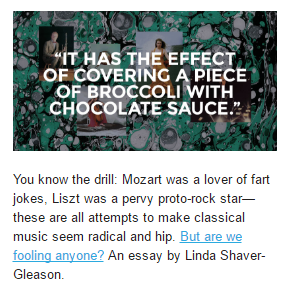
I have another debunking post in the works, but in the meantime, I wrote an essay for VAN Magazine about the cliché of equating composers with rock stars: "Classical Music Isn't Cool." Rather than give you a preview paragraph, this time I'll show you how VAN promoted it in their weekly newsletter:
You know the drill: Mozart was a lover of fart jokes, Liszt was a pervy proto-rock star--these are all attempts to make classical music seem radical and hip. But are we fooling anyone? An essay by Linda Shaver-Gleason

Since I couldn't in the essay, I'd like to take this opportunity to thank Emma Parker, Sarah Elaine Neill, Andrew Dell'Antonio, and Carl Shaver for their feedback on early drafts.

Perhaps you disagree with my bold assertion, and hearing about Berlioz's drug use is what got you to check out Symphonie Fantastique. If so, let me know! I'd love to hear other perspectives on this topic.

Next time: I scrutinize a potential solution to Elgar's enigma, and one news outlet's coverage of it.

Thursday, September 15, 2016

What did the Victorians think of music and sport?

I awoke yesterday morning to find that two different people had sent me links to the same New York Times article: “Why Not a College Degree in Sports?” In it, Roger Pielke, Jr. argues that college sports have a lot in common with the performing arts—they require specialized skills and training, and people pay to see the students perform—so it should be possible to earn a degree in basketball, just as someone can currently get a bachelor’s degree in viola performance (like I did).

I’m not opposed to the idea. There is a lot of overlap between athletes and musicians, between the psychological pressure of performing in the moment and the need to maintain physical health. Just as I had to take several classes in music theory and history, Pielke cites a proposed curriculum of “sports history, sports law, sports finance.” The sports history aspect is most appealing to me, as that can become a student’s entre into the humanities—pretty much any human endeavor reveals something about the society in which it developed, so I can envision classes like “Politics and the Modern Olympic Games,” or “Ancient Precursors to Soccer: Global Perspectives.”

The proposed sports degree does enter into the ongoing debate about what the “true” purpose of higher education should be. Is college supposed to train you for a career in a specific field, or provide you with a broader knowledge base? Few sports majors would become professional athletes, just like few performance majors are be able to support themselves purely by playing. Yet such a program could help develop the skills to find alternative jobs within the field—and, ideally in my view, intellectual skills that they could apply to other fields, as well.

But that debate is not really in the purview of this blog. This statement, however, is:
And beyond such economic disparities, class distinctions of 19th-century England still shape thinking about sport: Classical music is valued by high society, while sport is for the masses.
The second half of the sentence is a cliché. The sentence as a whole is inaccurate.
Wednesday, July 27, 2016

Opera! So highbrow, amirite?

I haven’t updated the blog in a while, mostly due to medical issues (I’m adjusting to a new chemotherapy regime). That hasn’t prevented people from writing stupid things about music, sadly. The study about how Mozart is better than ABBA for lowering your blood pressure is continuing to circulate, and I’ve already said my piece about articles like that.

Fortunately, for some bits of bad music journalism over the past month, other writers were quick to respond. Around Independence Day, a picture of Stravinsky made the rounds, purporting to be a mugshot from when he was arrested for his arrangement of “The Star-Spangled Banner.” Carly Carioli of The Boston Globe thoroughly debunked this myth. Accuracy triumphs again!

As for clichéd topics, Philip Clark of The Guardian lamented “Where have the great composers gone?”, yet another article about how music just isn’t as good as it used to be, you know, in the past. Joshua Kosman of the San Francisco Chronicle took him on directly and answered, “Looking for the great composers? They’re all around us.”

So, even though I wasn’t keeping my own blog current, I was at peace with how others were handling things and decided it wasn’t so bad to focus on my own recovery for a bit. But then the clichés struck in a medium very dear to my heart: the comic strip.

Friday, June 24, 2016

What is a “Masterpiece”?

UCLA musicologist (and friend of the blog) Robert Fink tagged me in a link to an essay about the watering down of the word “masterpiece.” As a lover of language, I do mourn the loss of specificity of certain words. Even though I acknowledge that language changes (and that it has to), I love the 18th century definitions of “sublime” and “picturesque,” and I wish that the former still conveyed a sense of overwhelming vastness while the latter still connoted variation and interesting juxtapositions.

But while Terry Teachout claims to be defending a dictionary definition in his article “‘Masterpieces’ Without Masters,” his sense of the word is tied up with a lot of Romanticized ideas of art and its production. And by “Romanticized,” I do mean that his way of addressing this topic is filled with ideas that originated in the 19th century. I have two main problems with Teachout’s essay: his rigid division between “popular culture” and “high art,” and his idea that a masterpiece must by definition exclude collaboration. To support this second point, Teachout makes many erroneous assumptions about how works of art, particularly classical music, are created.