Showing posts with label classical is cool. Show all posts

Friday, June 15, 2018

Did Stravinsky's The Rite of Spring incite a riot at its premiere?

I knew this entry was inevitable from the moment I had the idea to start this blog. Of all the classical music myths, this might be the one most deeply entrenched in the popular imagination: the riot at the premiere of Igor Stravinsky’s The Rite of Spring.

The Rite of Spring premiered on May 29, 1913 at the Théâtre des Champs-Élysées in Paris. The ballet depicts ritual sacrifice in prehistoric Russia, or at least what Stravinsky and his collaborators imagined “prehistoric Russia” to be. The premiere was expected to be a major cultural event, given the talent involved.

The Ballets Russes—literally, “Russian Ballet”—was a hot ticket, as Parisians were drawn to the Eastern exoticism of previous productions, including Firebird (1910) and Petrushka (1911), both of which had music composed by the young up-and-comer Stravinsky. Vaslav Nijinsky, the choreographer, was known for his shocking and often risqué choreography (such as his 1912 performance of Claude Debussy’s Prélude à l’Après-midi d'un faune, reproduced in this video).

The performance was unlike anything the audience expected: the costumes were ugly, the choreography heavy, and the music harsh. In the words of 21st-century music critic Ivan Hewett:
“The audience was shocked – and with good reason. Stravinsky’s score for The Rite of Spring contradicted every rule about what music should be. The sounds are often deliberately harsh…The music was cacophonously loud, assaulting the ears with thunderous percussion and shrieking brass. Rhythmically it was complex in a completely unprecedented way.”
Some in the audience booed and jeered at the performance, causing others to defend the artistic integrity of the ballet with shouts and insults, causing such a ruckus that no one could even hear the music, including the dancers. The fighting in the audience got so bad that some resorted to physical violence, causing a riot that overshadowed the actual performance.

So the story goes.

Even sites that aren’t devoted to classical music have published articles covering the riot, especially in light of the premiere’s centenary in 2013. As for classical music sites, you can count on it to appear on lists like “Top Five Crazy Riots in Classical Music” and “10 OMG moments in classical music” Radiolab devoted an episode of their podcast to reimagining the premiere “through the lens of modern neurology.” And, I confess, as a grad student I even taught this to a bunch of unsuspecting undergrads in a music appreciation course. But here’s the problem:

The riot never happened.

Thursday, February 9, 2017

Classical music isn't "cool": Essay for VAN Magazine

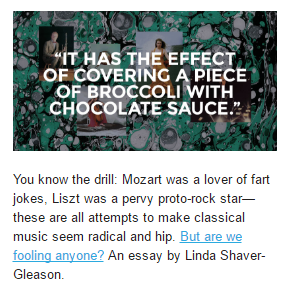
I have another debunking post in the works, but in the meantime, I wrote an essay for VAN Magazine about the cliché of equating composers with rock stars: "Classical Music Isn't Cool." Rather than give you a preview paragraph, this time I'll show you how VAN promoted it in their weekly newsletter:
You know the drill: Mozart was a lover of fart jokes, Liszt was a pervy proto-rock star--these are all attempts to make classical music seem radical and hip. But are we fooling anyone? An essay by Linda Shaver-Gleason

Since I couldn't in the essay, I'd like to take this opportunity to thank Emma Parker, Sarah Elaine Neill, Andrew Dell'Antonio, and Carl Shaver for their feedback on early drafts.

Perhaps you disagree with my bold assertion, and hearing about Berlioz's drug use is what got you to check out Symphonie Fantastique. If so, let me know! I'd love to hear other perspectives on this topic.

Next time: I scrutinize a potential solution to Elgar's enigma, and one news outlet's coverage of it.

Tuesday, January 17, 2017

Many Mozart Myths: A pauper’s grave, labor screams, and more!

Happy 261st! Don’t worry, we’ll
still treat you like you’re 11.
Wolfgang Amadeus Mozart’s birthday is nearly upon us: On January 27, he’ll be turning 261 years old. ’Tis the season for listicles touting the miraculous powers of the Mozart Effect (which I’ve discussed here and, more recently, in the article I wrote for The Outline). Some website or publication might mention his rivalry with Salieri, or extol his otherworldly perfection. But The Telegraph got a head start and already published “Myleene Klass on the enduring appeal of Mozart” (Warning: Video autoplays), an article filled with so many myths and clichés that debunking them might take care of my Mozart quota for a while.