From Linda: Hello, everyone! I want to alert you to the fact that this essay is a guest post by Michael Vincent. Not only is it informative and thoroughly researched, it fits with the overall mission of this blog. I am grateful that he shared this with me, and I hope you find it as fascinating as I do.
When in doubt, ask a musicologist. As Linda has noted elsewhere, musicologists are great for contextualizing music and history with larger ideas. But our discipline has blind spots. We train in European-style universities, where we sometimes continue to work. We tend to be Eurocentric, incorporating other perspectives but safely cordoning them off as secondary areas of interest. Owing to this blog’s mission, Linda hasn't shied away from the issue.
When I read this post from WQXR Blog on the origins of solfege, I was happy to see that the author consulted musicologist Andrew Dell’Antonio, who has contributed to Not Another Music History Cliché. Everything that James Bennett II (the WQXR author) writes conforms with what is commonly understood in our discipline—an improvement over an earlier essay that caught the attention of this blog. Bennett acknowledges complexities, since solfege is “found in musical cultures all over the world.” He specifies the subject of the post as “the form [of solfege] most associated with western European music.” He has done his due diligence in researching and presenting the information accurately. So what’s the issue?
It’s where Bennett writes “Guido d’Arezzo (ca. 991–after 1033), the monk to whom we attribute the beginnings of staff notation as we understand it today, also gets credit for solfège.” Bennett smartly hedges the language, noting that Guido “gets credit.” Yes, he does! While this level of information is appropriate for the reader of the WQXR blog, here we can get into why Guido gets credit: because of the Eurocentric perspective adopted by musicologists.
Showing posts with label guest posts. Show all posts
Showing posts with label guest posts. Show all posts
Thursday, May 17, 2018

Thursday, April 12, 2018
The Halls are Alive: Essay for VAN Magazine
Hello! Even though I haven't been updating the blog lately, I have been busy with other musicological endeavors. I discussed music, art, and philosophy on a local podcast (which hasn't posted yet), and I had a chat with BBC Radio 3's Tom Service for an upcoming episode of The Listening Service about my stance on whether music is a universal language. I'll post links to these once they go live.
Meanwhile, here's my latest article for VAN Magazine (who previously published my essay, "Classical Music Isn't Cool"): "The Halls are Alive."
I've also had a paper accepted to the "Music and Musicology in the Age of Post-Truth" conference in Dublin next September, and I've been writing program notes for a few new clients. Even so, I'm hoping to have a new post on The Telegraph's argument that "Classical music must ditch its name." Exciting times ahead!
Like what you’ve read?
Meanwhile, here's my latest article for VAN Magazine (who previously published my essay, "Classical Music Isn't Cool"): "The Halls are Alive."
 |
"So many facets of classical music culture are holdovers from the 19th century and at odds with 21st century society....Yet in this essay I defend the most Romantic of 19th-century institutions: the concert hall. Yes, the physical manifestations of music worship, structures so Romantic that they wouldn’t be foreign to Richard Wagner. Though some argue that the etiquette for concert halls is outdated, elitist, and partly responsible for classical music’s struggle to find new audiences, concert halls actually provide unique experiences that have become all too rare." Read more »
I've also had a paper accepted to the "Music and Musicology in the Age of Post-Truth" conference in Dublin next September, and I've been writing program notes for a few new clients. Even so, I'm hoping to have a new post on The Telegraph's argument that "Classical music must ditch its name." Exciting times ahead!
Like what you’ve read?
Wednesday, December 27, 2017
The Myth of the Canon's Invisible Hand (Guest post by Anne C. Shreffler)
From Linda: Hello, everyone! This year has been remarkable for (among other things) public debates about women's experiences in our society, from the Women's March to the #metoo campaign. Just as the previous two posts on this blog have featured a multitude of voices, this post comes from someone else: Harvard musicologist Anne Shreffler. Many thanks to Dr. Shreffler for contributing to our continued discussion of the classical music canon.
“But isn’t musical quality more important than gender?”
Anyone who has ever proposed a greater inclusion of women composers and composers of color—into a curriculum, a concert program, or an archive—is familiar with this kind of response. One of the most persistent myths in music history is that the classical music canon came about as the result of a rational, inevitable process that ensured the preservation of only the "best" works, those that "stood the test of time." An influential proponent of this view was the German musicologist Carl Dahlhaus, who maintained in 1977 that the musical canon was not made but "found." According to Dahlhaus, we can't shape or change the canon, since it was created long ago by the invisible hand of tradition.
How exactly is this selection process supposed to have worked? One imagines a fictional court of justice in the heavenly spheres, presided over by—whom? (God? St. Cecilia? Herbert von Karajan?), that conducts annual reviews of ALL the compositions by ALL the people, and hands down impartial judgment on their "musical quality." The verdict: Sibelius, yes; his contemporaries Amy Beach and Will Marion Cook, no.
 |
| Beethoven, the disembodied name of a musical deity, in Boston's Symphony Hall |
Anyone who has ever proposed a greater inclusion of women composers and composers of color—into a curriculum, a concert program, or an archive—is familiar with this kind of response. One of the most persistent myths in music history is that the classical music canon came about as the result of a rational, inevitable process that ensured the preservation of only the "best" works, those that "stood the test of time." An influential proponent of this view was the German musicologist Carl Dahlhaus, who maintained in 1977 that the musical canon was not made but "found." According to Dahlhaus, we can't shape or change the canon, since it was created long ago by the invisible hand of tradition.
How exactly is this selection process supposed to have worked? One imagines a fictional court of justice in the heavenly spheres, presided over by—whom? (God? St. Cecilia? Herbert von Karajan?), that conducts annual reviews of ALL the compositions by ALL the people, and hands down impartial judgment on their "musical quality." The verdict: Sibelius, yes; his contemporaries Amy Beach and Will Marion Cook, no.
Monday, April 10, 2017
Monteverdi at 450: Don’t Believe the Hype (Guest post by Andrew Dell'Antonio)
From Linda: Hello, everyone! I completed my eighteen treatments of brain radiation a little over a week ago, and as far as I can tell, I’m not experiencing much in the way of cognitive impairment. That’s particularly good news, considering that in the past month I’ve had some fantastic opportunities: I received a commission to write program notes for a concert by the Los Angeles Philharmonic, and I’ve been selected as a contestant for Jeopardy!, with the taping next week. So, even though I have a clear idea of what I want to blog about next, I haven’t had the time to write the posts.
But people keep being wrong on the internet, and I’m not the only one who cares. My friend and colleague Andrew Dell’Antonio (co-editor of The Avid Listener) spotted a trend in the way newspapers are using Claudio Monteverdi to boost tourism, and he offered to write a guest post. My sincere thanks to Andrew for his contribution!
As a long-time admirer of Linda Shaver-Gleason’s insights on the perils of musical-historical cliché, I am absolutely honored that she has given me this opportunity to have my say on an instance of celebratory flim-flam from my own musical-historical backyard.
We are in the 450th anniversary year of the birth of Claudio Monteverdi (1567-1643), verifiably one of the most prominent European musicians of the turn of the seventeenth century. Anniversaries bring celebrations, and several have already been underway, the most noteworthy sponsored by the town of Cremona, where he was born, but also at Mantua, where he built his reputation, and Venice, where he landed and put down roots for the last 30 years of his long and productive life.
Most recently hype has bubbled up in a pair of posts from the travel sections of UK newspaper web sites The Guardian and The Telegraph, in conjunction with a planned performance in Venice of the three surviving operas by Monteverdi by prominent English ensembles directed by John Eliot Gardiner. Stephen Pritchard of The Guardian gushes:
But people keep being wrong on the internet, and I’m not the only one who cares. My friend and colleague Andrew Dell’Antonio (co-editor of The Avid Listener) spotted a trend in the way newspapers are using Claudio Monteverdi to boost tourism, and he offered to write a guest post. My sincere thanks to Andrew for his contribution!
As a long-time admirer of Linda Shaver-Gleason’s insights on the perils of musical-historical cliché, I am absolutely honored that she has given me this opportunity to have my say on an instance of celebratory flim-flam from my own musical-historical backyard.
 |
| Claudio Monteverdi Portrait by Bernardo Strozzi |
Most recently hype has bubbled up in a pair of posts from the travel sections of UK newspaper web sites The Guardian and The Telegraph, in conjunction with a planned performance in Venice of the three surviving operas by Monteverdi by prominent English ensembles directed by John Eliot Gardiner. Stephen Pritchard of The Guardian gushes:
The first composer to break through convention and display the true nature of humanity… a man who moved music out of the Renaissance into the Baroque, as much a revolutionary in his own artform as his contemporaries Shakespeare, Galileo, Cervantes, Caravaggio and Rubens were in theirs.
Thursday, February 9, 2017
Classical music isn't "cool": Essay for VAN Magazine
I have another debunking post in the works, but in the meantime, I wrote an essay for VAN Magazine about the cliché of equating composers with rock stars: "Classical Music Isn't Cool." Rather than give you a preview paragraph, this time I'll show you how VAN promoted it in their weekly newsletter:
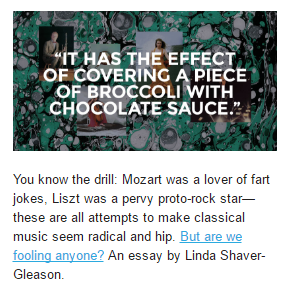
Since I couldn't in the essay, I'd like to take this opportunity to thank Emma Parker, Sarah Elaine Neill, Andrew Dell'Antonio, and Carl Shaver for their feedback on early drafts.
Perhaps you disagree with my bold assertion, and hearing about Berlioz's drug use is what got you to check out Symphonie Fantastique. If so, let me know! I'd love to hear other perspectives on this topic.
Next time: I scrutinize a potential solution to Elgar's enigma, and one news outlet's coverage of it.
Perhaps you disagree with my bold assertion, and hearing about Berlioz's drug use is what got you to check out Symphonie Fantastique. If so, let me know! I'd love to hear other perspectives on this topic.
Next time: I scrutinize a potential solution to Elgar's enigma, and one news outlet's coverage of it.
Tuesday, January 31, 2017
Myths about Beethoven's deafness: Guest post for The Avid Listener
After I've been teasing you about it for over a month, The Avid Listener published my essay "Beethoven’s Deafness and the Myth of the Isolated Artist" today! Here’s a preview:
The Avid Listener is a blog published by W.W. Norton & Company, intended to foster discussion in and beyond the classroom (hence the discussion questions at the end). I’m excited about this collaboration, as I got to blend my interests in musical mythbusting with their house style emphasizing multimedia presentations.
Also, I am very grateful for the input from Robin Wallace of Baylor University. He is currently writing an entire book devoted to Beethoven myths, and he was generous enough to share some of his drafts with me. He goes into more depth than I’m able to on this blog, so if this topic interests you, please check out his work!
I’m currently working on another off-blog essay about the cliché of making classical music look "cool," and I’m expecting that to be published next week. In the meantime, please enjoy the other wonderful essays on The Avid Listener, and keep sending me suspect links as you find them.
Beethoven’s disability forms a large part of our concept of him as the quintessential Romantic Hero, as it is a tragic flaw he must overcome to produce his great Art.
The above clip [from Mr. Holland's Opus] mentions two stories about Beethoven’s deafness that have circulated for centuries. In one, Beethoven waves his arms at the podium, oblivious to the fact that the orchestra cannot keep up. In the other, he saws off the legs of his piano so he can feel the vibrations through the floor.
Neither of these stories is true.
Read more »
 |
| The Avid Listener also has a spiffy logo. |
Also, I am very grateful for the input from Robin Wallace of Baylor University. He is currently writing an entire book devoted to Beethoven myths, and he was generous enough to share some of his drafts with me. He goes into more depth than I’m able to on this blog, so if this topic interests you, please check out his work!
I’m currently working on another off-blog essay about the cliché of making classical music look "cool," and I’m expecting that to be published next week. In the meantime, please enjoy the other wonderful essays on The Avid Listener, and keep sending me suspect links as you find them.
Wednesday, January 11, 2017
Announcement: Guest post for The Outline
Happy New Year! I hope you’ve had a wonderful holiday season. I’ve been busy writing. Fortunately (for me, but perhaps unfortunately for this blog), I’ve been working on articles for other sites. Unlike my post for Musicology Now, however, these articles are in line with the aim of this blog: busting musical myths.
Today, The Outline published my article, “You Don’t Need Science to Tell You Why You Like a Song.” This essay is like a companion piece to one of the first posts on this blog, “Science Proves Your Favorite Music is the Best.” My earlier post explored how classical music media outlets tend to be self-congratulatory about scientific studies involving classical music. Since The Outline doesn’t focus on classical music, though, I wrote about why we place so much emphasis on scientific (or scientistic) studies of music in the first place. I still mention the Mozart Effect, but I pair it with a ridiculous formula that claims to have determined the “10 most uplifting songs ever,” which are astonishingly all Dad Rock Standards. Here’s a preview:
Today, The Outline published my article, “You Don’t Need Science to Tell You Why You Like a Song.” This essay is like a companion piece to one of the first posts on this blog, “Science Proves Your Favorite Music is the Best.” My earlier post explored how classical music media outlets tend to be self-congratulatory about scientific studies involving classical music. Since The Outline doesn’t focus on classical music, though, I wrote about why we place so much emphasis on scientific (or scientistic) studies of music in the first place. I still mention the Mozart Effect, but I pair it with a ridiculous formula that claims to have determined the “10 most uplifting songs ever,” which are astonishingly all Dad Rock Standards. Here’s a preview:
Thursday, December 22, 2016
Announcement: Musicology Now guest post!
Although I haven't updated the blog recently, I've spent a lot of time writing about it. This week, I wrote a post for Musicology Now (yes, the same Musicology Now that I criticized in a previous post, now with a new editorial board). In it, I reflect on my experience with this blog and what I've learned about doing public musicology on the internet, in the hopes of passing along some advice to others who want to try it for themselves. I don't debunk any musical myths in this essay, but if you're interested in learning about my process and goals, please check it out! Here's a preview:
Have a merry Christmas, happy new year, and marvelous any other holiday you're celebrating! I look forward to busting more musical myths with you in 2017.
Also, in the wake of articles celebrating Beethoven's birthday on December 16th, I've been working on a post about myths pertaining to his deafness. That post will probably be published early in the new year.Read more »
- Your job is to stimulate enthusiasm, not quash it. Since I threw myself into the business of debunking myths, I’m at risk of being the pedant who derails an interesting conversation with, “Well, actually…” Sometimes I worry I’m so caught up in correcting misconceptions about music that I give the impression I don’t actually like it. That’s motivated me to write more than just corrections, to explain why the history matters and hopefully replace the warm fuzzies of a feel-good false narrative with an awed appreciation for history.
Have a merry Christmas, happy new year, and marvelous any other holiday you're celebrating! I look forward to busting more musical myths with you in 2017.
Subscribe to:
Posts (Atom)