Thursday, December 7, 2017

Did Bach raise 20 children? Writing composer biographies for kids

Hello! It’s been months since I’ve last updated, and I regret that the hiatus lasted so long. It was mostly due to medical issues; after my successful round of brain radiation, I started a particularly brutal chemo treatment that saps me of energy and makes it difficult to walk. But I’m still recovering.

As I mentioned in the intro to Andrew Dell’Antonio’s guest post, I was indeed on Jeopardy! You can watch the full episode online (assuming Sony hasn’t had the video removed), or if you just want results, you can check J!-Archive. (I was wearing a wig for that episode because radiation left me bald.) If you watch the show, you’ll see that I talked about this blog in my one-on-one with Alex Trebek! I made a passing reference to Mozart and Salieri before mentioning that Bach wasn’t quite forgotten after his death. Wrapping up the interview, Alex mentioned Bach having “lots of children,” and I agreed.

In the very first post on this blog—indeed, the very first sentence—I mention that Bach having a bunch of children is one of those facts that nearly every classical music lover already knows. It is technically correct that Bach fathered twenty children.
Futurama meme: You are technically correct...the best kind of correct.
And technically correct is the best kind of correct.

However, I’ve discovered that this fact leads some people to create a mental image that is inaccurate. For example, I recently found a description on Amazon of a Bach biography that says it shows, “how he helped his wife Magdalena put the twenty children to bed every night.” This is completely false.

Monday, April 10, 2017

Monteverdi at 450: Don’t Believe the Hype (Guest post by Andrew Dell'Antonio)

From Linda: Hello, everyone! I completed my eighteen treatments of brain radiation a little over a week ago, and as far as I can tell, I’m not experiencing much in the way of cognitive impairment. That’s particularly good news, considering that in the past month I’ve had some fantastic opportunities: I received a commission to write program notes for a concert by the Los Angeles Philharmonic, and I’ve been selected as a contestant for Jeopardy!, with the taping next week. So, even though I have a clear idea of what I want to blog about next, I haven’t had the time to write the posts.

But people keep being wrong on the internet, and I’m not the only one who cares. My friend and colleague Andrew Dell’Antonio (co-editor of The Avid Listener) spotted a trend in the way newspapers are using Claudio Monteverdi to boost tourism, and he offered to write a guest post. My sincere thanks to Andrew for his contribution!

As a long-time admirer of Linda Shaver-Gleason’s insights on the perils of musical-historical cliché, I am absolutely honored that she has given me this opportunity to have my say on an instance of celebratory flim-flam from my own musical-historical backyard.

Claudio Monteverdi
Portrait by Bernardo Strozzi
We are in the 450th anniversary year of the birth of Claudio Monteverdi (1567-1643), verifiably one of the most prominent European musicians of the turn of the seventeenth century.  Anniversaries bring celebrations, and several have already been underway, the most noteworthy sponsored by the town of Cremona, where he was born, but also at Mantua, where he built his reputation, and Venice, where he landed and put down roots for the last 30 years of his long and productive life.

Most recently hype has bubbled up in a pair of posts from the travel sections of UK newspaper web sites The Guardian and The Telegraph, in conjunction with a planned performance in Venice of the three surviving operas by Monteverdi by prominent English ensembles directed by John Eliot Gardiner. Stephen Pritchard of The Guardian gushes:
The first composer to break through convention and display the true nature of humanity… a man who moved music out of the Renaissance into the Baroque, as much a revolutionary in his own artform as his contemporaries Shakespeare, Galileo, Cervantes, Caravaggio and Rubens were in theirs.

Tuesday, March 7, 2017

Problems with “Evolution” Narratives

A side note before I get into this post: I’ve recently received some unfortunate medical news that will probably affect my ability to update this blog. In a previous post, I’ve mentioned that I have cancer. A few weeks ago, we learned that it has spread to my brain, and that I’ll be undergoing full brain radiation (starting this afternoon!), which will affect my short-term memory and ability to concentrate. In the future, I hope to work on writing with the extra mental challenges, but in the meantime, even just finding out about the cancer spreading has made it difficult to focus.

…Which is why I haven’t updated for a while, despite there being plenty of musical misconceptions to clear up. I’ve actually had two potential posts on my agenda for over a week: a take-down of a “new” (actually just recirculating) theory about Beethoven’s infamous Immortal Beloved, and a Twitter conversation I had last week about whether classical music can be considered political (my stance: Of course it’s political!). I’m still planning to post about those, as I think they’re both interesting and important. But what ultimately motivated me to update the blog today was a cartoon:

“The Evolution of Classical Composition” is as adorable as it is problematic!
Note: The panels read down first, then right. Click link for larger version.
Source: http://classic-jenny.tumblr.com

Monday, February 13, 2017

Has Elgar’s Enigma finally been cracked? (Spoiler: No.)

Check out this sensational headline, fresh from Facebook!
“Did a Violin Teacher From Plano, Texas Solve
the World’s Greatest Classical Music Mystery?”
I don’t know, but all these superimposed notes look pretty convincing!
This story has something for everyone: An unassuming person from Middle America finds the solution that has eluded scholars and specialists for generations! If you’re into classical music, this is a major finding that may change the way you listen to a major piece in the repertoire! If you’re an average dude, your kind has just scored a major victory over educated elitists with nothing but gumption and a little help from, yes, God above.

Ah, but remember Betteridge’s Law of Headlines (which I’ve discussed on this blog before): “Any headline that ends in a question mark can be answered by the word no.” Admittedly, this “law” is intended more for humor than accuracy, but it holds true in this case. No, Bob Padgett did not crack the “Enigma” of Edward Elgar’s famous variations.

Thursday, February 9, 2017

Classical music isn't "cool": Essay for VAN Magazine

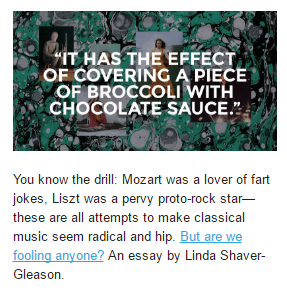
I have another debunking post in the works, but in the meantime, I wrote an essay for VAN Magazine about the cliché of equating composers with rock stars: "Classical Music Isn't Cool." Rather than give you a preview paragraph, this time I'll show you how VAN promoted it in their weekly newsletter:
You know the drill: Mozart was a lover of fart jokes, Liszt was a pervy proto-rock star--these are all attempts to make classical music seem radical and hip. But are we fooling anyone? An essay by Linda Shaver-Gleason

Since I couldn't in the essay, I'd like to take this opportunity to thank Emma Parker, Sarah Elaine Neill, Andrew Dell'Antonio, and Carl Shaver for their feedback on early drafts.

Perhaps you disagree with my bold assertion, and hearing about Berlioz's drug use is what got you to check out Symphonie Fantastique. If so, let me know! I'd love to hear other perspectives on this topic.

Next time: I scrutinize a potential solution to Elgar's enigma, and one news outlet's coverage of it.